
After the beginner courses we have a few lessons to offer. So far this is only for the registered participants of the course “Archery for Advanced” at the University Stuttgart. But we will offer this kind of courses and workshops for other archer*ettes too, we just have to figure out how yet.
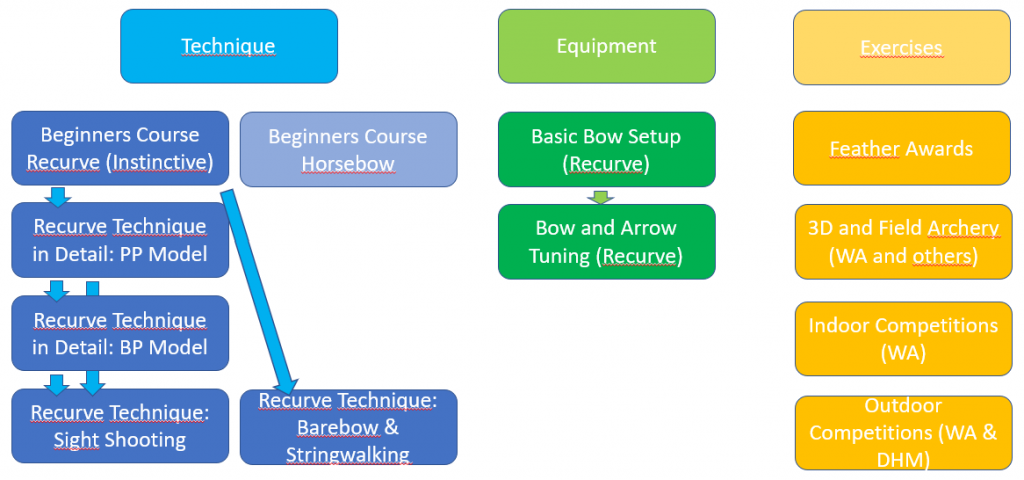
We have three tracks of courses and workshops:
- the technique track, where you will learn how to shoot, how to use different techniques and how to improve your shooting technique,
- in the equipment track it is all about your equipment, how to set it up, how to tune and improve on it, and also how to keep it clean and live as long as possible (so obviously these are workshops with your bows and arrows),
- and then finally the exercises track, with all kind of different goals to train for and explanations of the rulesets.
Some courses have logical prerequisits, which you can see following the arrows. What I did not include in this graph, to not over complicate it, are prereqisits between the different tracks. It is logical, that you need the “Beginners Course Recurve” to go to the exercises for WA Competitions – but you could be an advanced compound archer who joined us, who of course could take those exercises, too. You can take “Basic Bow Setup” without any previous course, but it is probably not very useful to you. So you see, it gets complicated here, and I don’t want to make the graph a chaotic mess.
The following course descriptions will move to their own site, when they get bigger.
Technique
Beginners Course Recurve (Instinctive)
We teach the basic archery techniques with the focus on instinctive (or intuitive) archery, with mediterranean grip and face anchor. More on AHS Bogensport – the courses.
- Regular Lesson: 3 Sessions, 2 hours each. Best practice to space it over three weeks.
- Short Workshop: around 3 hours is possible, but it will be more an event or introduction, than finished learning.
- Prerequisites: none.
Beginners Course Horsebow (Thumb Draw)
We teach the basic horsebow archery techniques, which inherently is instinctive (or intuitive) archery, with the focus on thumb draw. More on AHS Bogensport – the courses.
- Regular Lesson: 3 Sessions, 2 hours each. Best practice to space it over three weeks.
- Short Workshop: around 3 hours is possible, but it will be more an event or introduction, than finished learning.
- Prerequisites: none.
Recurve Technique in Detail: PP Model
The PP Model is the Position Phase Model. The german archery association teaches this style of archery, especially to the new olympic children and youth cadres. You will learn this model in detail and with exercises.
This model is tailored specifically for olympic archery with sights, but it will help with barebow archery just as much (and works in general for horsebow, too, of course). You can find a short description of the model here (sorry only availabe in german from the DSB).
- Introduction and Overview: 1,5 hours
- Regular lesson: 4-6 sessions, 1,5 hours each.
- Prerequisites: Beginners Course Recurve (Instinctive or Horsebow)
Recurve Technique in Detail: BP Model
The BP Model is the Movement Phase Model (in german Bewegungs-Phasen-Model). This model is an extension of the PP Model, which focuses on the minute movements between the different static position phases. The german archery association teaches this style of archery, especially to the new olympic children and youth cadres. You will learn this model in detail and with exercises.
This model is tailored specifically for olympic archery with sights, but it will help with barebow archery just as much. You can find a short description of the model here (sorry only availabe in german from the DSB).
- Introduction and Overview: 1,5 hours
- Regular lesson: 4-6 sessions, 1,5 hours each.
- Prerequisites: detailed knowledge of PP Model
Recurve Technique: Sight Shooting
Once you know how to use a bow, you can also learn how to use a sight. You will learn how a sight works and how to use it. Ideally you know the PP Model before, but you will need it at least directly afterwards.
- Regular lesson: 1,5 hours
- Prerequisites: Beginners Course Recurve (Instinctive), knowledge of PP model is very recommended.
Recurve Technique: Barebow & Stringwalking
Barebow evolved from the instinctive archery, with the goal to use an aiming technique. There are a few techniques, which I will explain shortly here, but the focus is on the stringwalking technique.
- Regular lesson: 1,5 hours
- Prerequisites: Beginners Course Recurve (Instinctive), solid technique is recommended.
Equipment
Basic Bow Setup (Recurve)
You got a new recurve and don’t know what to do now? Or you never learned it in your old club?
This workshop will explain how (and why) to setup your recurve to the basic setting. This is tailored for modern take down recurves mostly, since there is seemingly a lot to setup. But the basics is true for nearly all kind of bows.
- Regular lesson: 1,5 hours
- Prerequisites: having your own ILF recurve bow is recommended.
Bow and Arrow Tuning (Recurve)
You got your basic setup, but something just doesn’t feel right? Or you just want to tweak it and get the best tuning out of your equipment?
This workshop will explain how to tune your bow: button, nockingpoint, sight, tiller, etc… the basic setup is fitting most archers, especially beginners, just fine. But to get the most out of your bow, it can be improved upon.
Another important part is your arrow. Beginners usually buy ready made arrows from the shelf, sometimes even advanced archers never really build there own arrows. We will explain what role each part of the arrow plays and how to tweak it to the optimal result.
- Overview bow and arrow tuning: 1,5 hours
- Regular lesson: 1,5 hours for bow setup
- Regular lesson: 1,5 hours for arrow setup
- Prerequisites: Basic Bow Setup (Recurve), having your own ILF recurve bow is recommended.
Exercises
Feather and Arrow Awards (WA)
The WA (World Archery Association) established a few awards. Most of them you can only earn in official WA competitions, but the feathers you can earn in your club and can be awarded by a trainer.
I will explain how you can earn them, and you can try to get the first one right away.
You can also find all official information at https://www.worldarchery.sport/sport/education/badge-awards – you will find all awards there, for the F&A Award look for “Beginner badges”.
- Regular lesson: 1,5 hours
3D and Field Archery (WA and others)
3D and Field archery are competition types defined by the WA. And I will explain the ruleset. But for 3D Archery there are also other rulesets, you could either use at an open 3D parcours for yourself, or you can find competitions with other rulesets.
In both types you need a few additional techniques, like shooting up and down, or having difficult ground to stand on.
You can find the official information at https://www.worldarchery.sport/rulebook – the contents of this lesson are in Book 4.
- Regular lesson: 1,5 hours
Indoor Competitions (WA)
I will explain the standard WA indoor competition and show you some practicing techniques.
You can find the official information at https://www.worldarchery.sport/rulebook – the contents of this lesson are in Book 3.
- Regular lesson: 1,5 hours
Outdoor Competitions (WA & DHM)
I will explain the standard WA outdoor competition and show you some practicing techniques. The DHM (the german university competition) also uses this ruleset.
You can find the official information at https://www.worldarchery.sport/rulebook – the contents of this lesson are in Book 3.
- Regular lesson: 1,5 hours