How do i find out which Eye is dominant for me?
There are a few possible tests, I mention my prefered ones here.
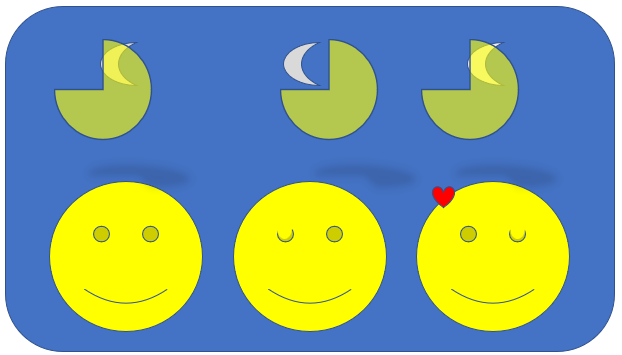
First, the method that is a little easier to explain, the Thumbs-Up Method:
- Stretch out one of your arms (start with your dominant if you will), make a fist, thumbs up.
- Keep both eyes open
- Look for a spot some distance away, like the moon, and cover it with your thumb.
- Now open and close one eye or the other. You see the moon covered, when your dominant eye is open, and you will see your thumb jump to the side, when your non-dominant eye is open. When it jumps with both eyes, your eyes might be very equally dominant.
- Now you have your dominant eye, the one, when the moon is covered.
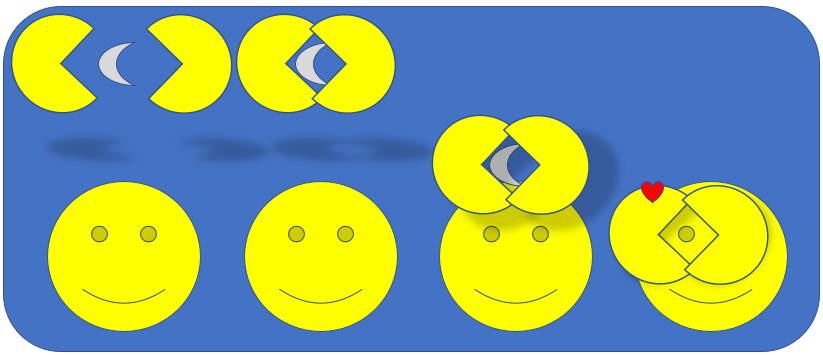
Another method I usually use, because it is more reliable is the Window Method:
- Stretch out both arms and form a diamond or a triangle with both your thumbs and index fingers to form a small window frame
- Keep both eyes open at all times now, never close them (you can blink of course)
- Look for a spot some distance away, like the moon, and bring it in your window
- concentrate on the moon only and make your finger window smaller, to the point where you nearly only see the moon in it
- now stay concentrated on the moon, and bring your hands closer to your face
- once your hands touch your face (or shortly before) you will notice, that your finger window is in front of only one of your eyes
- et voilà, this is your dominant eye.
There is always some debate, whether it is better or even necessary to test for eye-dominance and shoot accordingly a left or right handed bow. I try to explain this in a neutral way, and at the end I will add my view on it.
I use the terms left handed and right handed bow a few times now. So you need to know what it means. Left handed bows are held in the right hand and you draw the string with your left. For Right handed bows the other way round. I will also use the shortend form RH and LH if I refer to the bow from now on, to get you away from the confusing term “Righthanded” not refering to your dominant hand.
What is Eye-Dominance in the first place?
(click on arrow to read)
The human body seems to be symmetrical, but it never is – there are actual studies that show, how weird a symmetrical face would look like. So, we have a preferred hand or a hand we are better able to do fine manipulation, both need not be the same, but they usually are.
And likewise we have an eye that is dominant over the other. You might have a bad eye, and the other eye might automatically take over the role of dominance. Or you have just very different eyes, like me, where one works better close-distance, the other at far-distance. There are a few possibilities, and you might even have two near-perfect-equal dominant eyes.
There are scientific studies that investigate if eye-dominance and handedness go hand in hand (no pun inteded), if there are statistical correlations or evolutionary reasons behind. I could cite a few papers (and I might add that later here), but I do not want to write a doctoral thesis here, so allow me to just highlight the possibilites, that are discussed here (and that are not proven, nor are they my view at this time):
Handedness and Eye-Dominance have a high correlation. Meaning a left handed person has also very likely a left dominant eye, and a right handed person has very likely a right dominant eye. Cross-Dominance is more rare (or statistically more unlikely) – being left handed with a right dominant eye and vice versa. (If you are interested, here is one of the papers https://pubmed.ncbi.nlm.nih.gov/15513026/ from a medical research journal).
Why is this? Well, also a lot of possible explanations, here is one: if your right eye is dominant (as a baby) you will more likely notice some toy on your right body side, than on your left, and which hand will you grab it with? The closer one, in this case, the right one. This is one possible explanations, why there is such a high correlation. But why is there cross-dominance then?
Why is it important (or not)?
(click on arrow to read)
You will see I can not fully leave my point of view out here now, since this questions asks for an opinion. I will try to explain my reasoning as neutral as possible.
In archery it is important to be able to judge distances. Depending on the type of archery you do, it might be more or less important. If for example you only shoot indoors at 18m and never do other distances, it will be less important. If, on the other hand, you are doing 3D Archery with unknown distances, you will need it very much.
To be able to judge or estimate distances, you need stereovision – both eyes open. Of course there are estimation tactics that can bypass this, but lets keep it easy for now – and even than, you need to know, that you need other estimation tactics and have to learn them.
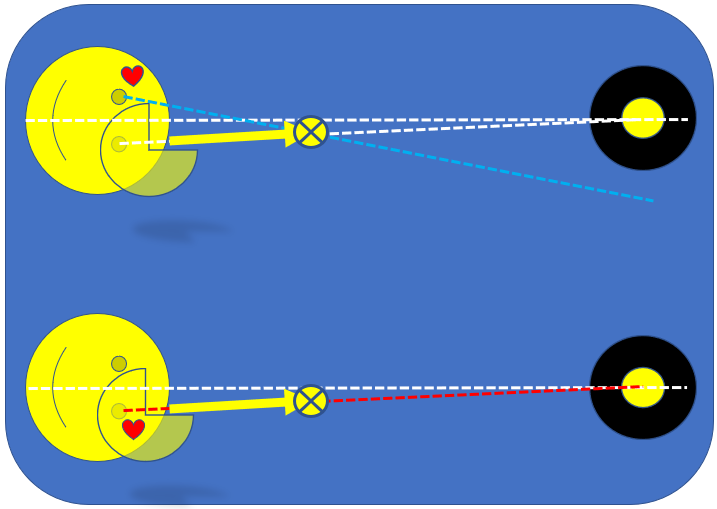
Now, if you follow this logic, with both eyes open, your aiming process will suffer if your non-dominant eye is not closer to the arrow and the viewpoint is not parallel to the arrows flight path. To compensate for that, you might have to use an eyepatch (not a pirates eyepatch, but an archers eyepatch, which often is a white opaque plastic cover) on your dominant eye or your arrow is either always off to the left or right or your aim will constantly flicker. You can try that easily for yourself with the Thumbs-Up Method:
- Stretch out one of your arms (start with your dominant if you will), make a fist, thumbs up.
- Keep both eyes open
- Look for a spot some distance away, like the moon, and cover it with your thumb.
- Now open and close one eye or the other. You see the moon covered, when your dominant eye is open, and you will see your thumb jump to the side, when your non-dominant eye is open. When it jumps with both eyes, your eyes might be very equally dominant.
- Now you have your dominant eye, the one, when the moon is covered.
Now imagine your thumb being your arrow tip or your sight cross, now draw a line from your dominant eye to your thumb (this is your arrow – works only if you have your body and arm aligned as if shooting). You can set your other fist below your eye and point to your finger tip with the index finger, this is the path your arrow would take. And repeat on the other arm. You can easily see the advantage or disadvantage of both sides, you see where the arrow would point at and what you would hit. For example: if you are right eye-dominant and have your right arm out (using a RH bow) your index finger under your right eye pointing at your thumb points directly at the target. With the index finger below your left eye you cross the line and hit somewhere to the right of the target. And that is where you naturally, instinctively would hit with your arrow.
As a sidenote. You might have noticed the little afterimage if you have both eyes open, as if you could look through your thumb? That was the image of your non-dominant eye and that was stereovision. That is what you need to estimate distances. If you didn’t notice, do the test again, and concentrate on what more you see, when you open your non-dominant eye. That is also the exact same principle (or one of them) how robots can learn to estimate distances with two camera images overlayed, and you might also know or heard of the 3D pictures, where a picture suddenly pops out of a page, it also uses that same principle. 3D cinemas use something similar, but their trick wouldn’t work if we would not have stereovision (which it doesn’t if you are visually impaired in that way).
As I mentioned there are a few factors, when it is not important (or not as much), and a few compensation methods. I just mentioned one, where one eye is way more dominant than the other, that means I bascially have a similar effect as if I would wear an eye-patch constantly over my left eye. Which is exactly what you could use, to compensate if you are using a RH bow with left eye dominance (or vice versa), but a little bit different than with my eyes (which I cannot change).
- Very different dominant eyes.
- Eye-patch (for archery) over one eye. If you are using a LH bow, your patch is on your right eye, for a RH bow on your left eye. To remember it easily: your eye closer to the arrow must be open.
- Adjusting the sight. If you are using a sight, you could compensate by adjusting the cross.
- A very short introduction course, a short teamworkshop or doing a short event, like a birthday party for kids. Then I also just mention, that it might not be totally correct, but just use your dominant hand for drawing. It is easier and faster, and you want them to shoot a lot, not explain too much. Or even easier, just hand out RH bows, and explain to everybody the same, also left and right might get mixed up, esp. bad with kids.
- Close one eye – on the side you hold the bow, not your drawing side (again, your eye closer to the arrow must stay open). I do not recommend that, but that would be a plausible solution if you only shoot one distance, for example if you only ever shoot 18m indoors.
You might say, in horsebow archery it is not important, because I have to be able to shoot with both sides (depending on the way of horsebow archery you follow, of course). And that is true, but that is about your handedness more, than it is about your eye-dominance. You need to practice RH and LH shooting. But if you want to hit what you are aiming for, you still need to know – maybe even more so – which of your eyes is dominant. Because you might have to implement a compensation technique when shooting on your non-(eye)dominant side and not use it on the other side or you will always miss on one side. Experienced horsebow archers might disagree with me here, but think about it for a second: you will have learned to compensate for it over time and with much practice automatically, or better, instinctively and intuitively. Thats how intuitive archery works. What I am saying here is, if you would have been aware of it, it might have worked a little faster, because for example you would have known, that for your LH side you have to aim to the right.